
Renting a Hall Instead of a Room: Farm Economics at 1 PH/s
A hosted slot changes the building, the power feed and who answers the phone at midnight. It does not change what the pool pays for shares. At 1 PH/s the credit is 0.00001869 BTC an hour, and 72 hours of steady running comes to 0.00134582 BTC, or $113.98 at $84,692. Whether that is a good trade depends on an invoice the pool never sends.

Key takeaways
- At 1 PH/s, one day of uptime credits 0.00044861 BTC, or $37.99 at the reference price.
- Three days at the same rate reach 0.00134582 BTC, with each 12-hour block adding 0.0002243 BTC.
- A host bills for space, power, cooling and labour, none of which appear in the pool's credit line.
- Compare quotes on all-in cost per kilowatt-hour plus a written uptime clause, not on photographs.
The credit line does not know your postcode
Under PPS+, the block-reward part of a payout settles hourly against current difficulty. That rule follows the shares your machines submit, so a rig in a shed and an identical rig in a four-row hall produce the same credit at the same hashrate. The network total, 1,003 EH/s on 21 Sept 2026, is the same denominator for both of them.
Fix that in your head before reading a hosting contract, because it splits the decision in two. One half is mining arithmetic, which you can compute to eight decimal places. The other half is a service agreement covering electricity, repairs, notice periods and access. A slot is only dear or cheap against the second half; the first half is identical wherever the machine stands.
Seventy-two hours at four checkpoints
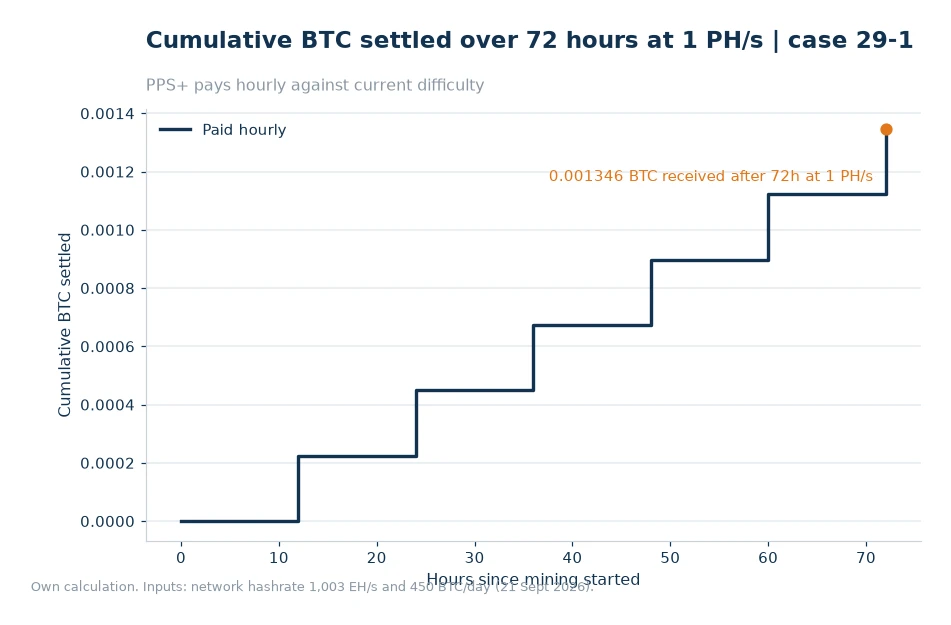
The run below assumes 1 PH/s and no downtime. The hourly figure of 0.000018692 BTC is the daily credit divided by 24, so totals rise in a straight line until a difficulty change interrupts the sequence.
| Window | BTC in window | Cumulative BTC | Value at $84,692 |
|---|---|---|---|
| 12 hours | 0.0002243 | 0.0002243 | $19.00 |
| 24 hours | 0.00022431 | 0.00044861 | $37.99 |
| 48 hours | 0.00044860 | 0.00089721 | $75.99 |
| 72 hours | 0.00044861 | 0.00134582 | $113.98 |
The right-hand column is the one to hold against a monthly invoice. Divide the host's charge by 30 to get a daily cost, then set it beside $37.99 at this hashrate. A slot priced above the daily credit is not automatically a bad deal, since it may include repairs and a strong uptime record, but the gap has to be justified by something the contract names in writing.
What the host sells that the pool cannot
Electricity dominates. A hall buys power on a business tariff, adds cooling load, and bills per kilowatt-hour or per machine. A miner's consumption is roughly fixed while its output moves with difficulty and price, so the ratio between them drifts. A contract signed when that ratio looked comfortable can look thin after two difficulty adjustments.
The rest of the service is quieter: spare parts, a technician on shift, network capacity, physical security, and the paperwork that lets hardware leave when you do. None of those raise the credit line. All of them raise the odds that the credit line keeps arriving every hour, which is the product actually being sold.
Sizing the slot to the machine
Efficiency decides how much of the credit a power bill can eat. Take a rig drawing 20 J/TH: 1 PH/s means 20 kW at the wall, which is 480 kWh a day. At $0.06 per kWh that is $28.80, against a gross credit of $37.99. The margin is thin enough that a host charging $0.08 turns a working operation into a flat one, and that calculation needs no price forecast at all.
Run it in that order every time: nameplate efficiency, hashrate, kilowatt-hours, tariff, then the credit. Doing it the other way, starting from a monthly figure and working backwards, hides the two variables that actually move, which are the tariff and the machine's draw under load. A clamp meter on the feed settles the second one better than a datasheet does.
Worked example
Start with the network totals and walk forward to the 72-hour figure in the chart.
- Network subsidy per day: 3.125 BTC × 144 blocks = 450 BTC.
- BTC per TH/s per day: 450 ÷ 1,003,107,267 = 0.00000044861.
- 1 PH/s is 1,000 TH/s: 1,000 × 0.00000044861 = 0.00044861 BTC a day.
- Hourly credit: 0.00044861 ÷ 24 = 0.000018692 BTC, the 1.869e-05 on the chart axis.
- Twelve hours: 12 × 0.000018692 = 0.0002243 BTC.
- Forty-eight hours: 48 × 0.000018692 = 0.00089721 BTC, or $75.99.
- Seventy-two hours: 72 × 0.000018692 = 0.00134582 BTC, and 0.00134582 × 84,692 = $113.98.
- A two-hour outage inside that window would remove 0.00003738 BTC, about $3.17, which is small once but expensive as a weekly habit.
Four questions that sort the quotes
Ask each host for the all-in rate per kilowatt-hour including cooling, plus the consumption they assume per machine. Then ask what the fee becomes when a unit is offline for a reason outside your control. A host that keeps charging through a substation failure is selling a different product from one that pauses the meter.
The last two are about repairs and exit. Who pays for a failed hash board, and how long may a machine sit idle before it is replaced? What notice do you give, and does the hardware ship back at your cost or theirs? Written answers beat a site visit, because they can be compared line by line with the next quote.
One more item belongs on the list: the currency of the invoice. A host billing in dollars leaves the miner carrying the whole swing in coin price, while a host billing in bitcoin shares part of it. Neither arrangement is wrong, but the two produce very different cash-flow shapes at the same headline rate, and the difference only shows up in a month when the price moves hard.
Keep the account, keep the record
The pool account, payout address and credit history stay in the miner's name in a hosting arrangement. That is the only independent record you own. Check the host's reported hashrate against the pool's figure for the first week; a persistent gap of a few percent is a conversation, not a rounding error, and it is easier to raise while the machines are still under a warranty conversation.
The ViaBTC Mining Farms listing shows the shape of the hosting market, and the Miner Hosting directory covers providers that take third-party machines. Neither replaces a contract review. Both shorten the first pass, when the categories matter more than the sales copy.
Frequently asked questions
Does a hosted slot change the 1 PH/s credit?
No. The credit follows shares and difficulty, so 1 PH/s earns 0.00001869 BTC an hour and 0.00134582 BTC over 72 hours whether the hardware sits at home or in a hall.
What should I compare first between two hosts?
The all-in cost per kilowatt-hour including cooling, set against the daily credit of 0.00044861 BTC at 1 PH/s, which is $37.99 at $84,692 per BTC.
Who controls the pool account in a hosting deal?
The miner does. The host supplies space, power, cooling and technicians, while the payout address and the credit history stay with the account holder.
Put both ledgers on one page
Write the daily credit at your hashrate on one line and the all-in daily cost on the next. At 1 PH/s the first line is $37.99 at the reference price, and it moves with difficulty every 2,016 blocks. If the second line leaves a margin you would still accept after a 10% difficulty rise, the arrangement has room. If it does not, no amount of facility quality repairs the sum.
The Profit Calculator produces the first line in dollars at current difficulty and can include merged-mining output. The second line is a question for the host, and the useful answer is a number rather than a phrase about partnership.
Sources: the ViaBTC farms, companies and pricing pages for hosting categories and the listed 4%[1]. Network inputs read 21 Sept 2026: 1,003 EH/s, difficulty 132.76 T, 3.125 BTC per block, 144 blocks a day, BTC $84,692. Credit figures are arithmetic on those inputs and assume continuous uptime; published 22 Oct 2026.