
Electricity Cost and Miner Breakeven, Worked Through
A 20 J/TH machine breaks even on block-reward income at an electricity price of about $0.0842 per kWh before fees, and about $0.0808 per kWh after the listed 4% PPS+ fee. That pair of numbers decides whether a rig earns or drains money, and it is the calculation owners skip most often. The arithmetic below runs at network difficulty 132.76 T and a BTC price of $85,294.

Key takeaways
- At 20 J/TH each TH/s draws 0.48 kWh a day, so breakeven sits at $0.0842/kWh gross and $0.0808/kWh after the listed 4% block-reward fee.
- Efficiency moves the line hard: 15 J/TH tolerates $0.1122/kWh, while 30 J/TH needs power under $0.0561/kWh.
- On a $0.06/kWh supply a 100 TH/s machine pays $2.88 a day for power against $3.88 of after-fee income, a margin near $1.00.
- Breakeven is quoted per TH/s, so it never improves with scale, only the size of the margin does.
Breakeven is a division, not an opinion
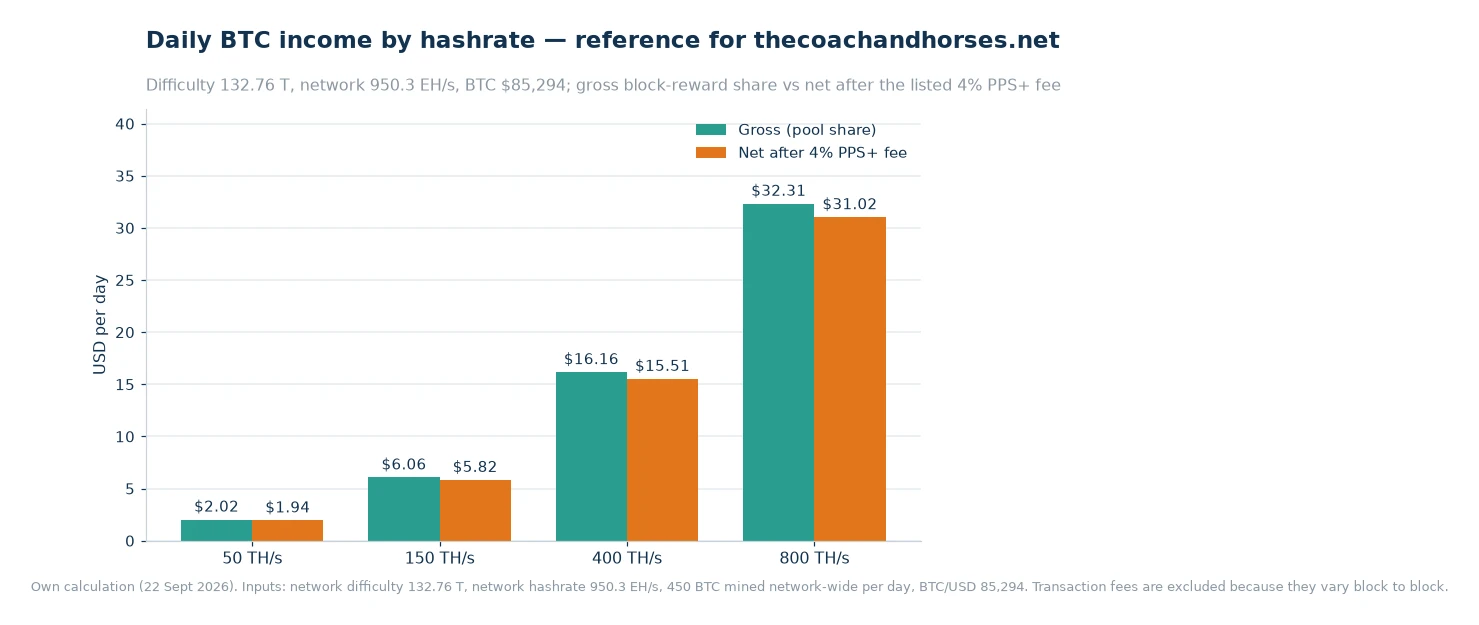
Start with what a terahash produces. With network difficulty at 132.76 T and an implied network hashrate of 950.3 EH/s, one TH/s earns roughly 0.0000004735 BTC a day, which is $0.0404 at $85,294 per BTC. The listed 4% fee on the PPS-settled block reward leaves $0.0388 of that in the account.
Now price the power. A machine rated at 20 J/TH burns 20 joules every second for each terahash it produces, which is 20 W per TH/s, or 0.02 kW. Across a full day that comes to 0.48 kWh per TH/s. Divide the gross figure by it and the breakeven power price is $0.0842 per kWh. Divide the after-fee figure instead and it is $0.0808 per kWh.
The most useful property of that number is that hashrate cancels out of it. Two machines with the same efficiency share the same breakeven line whether they produce 40 TH/s or 400 TH/s. Scale changes how much money sits above or below the line, never where the line is drawn.
What moves your breakeven price
Three inputs shift the line: the J/TH rating, the fee basis you measure against, and the price you actually pay per kilowatt hour. The first two are published figures you can read before spending anything. The third depends on the contract, and the number that counts is the one on the bill, after fans, transformers and building cooling have taken their share.
| Efficiency | Power per TH/s per day | Breakeven before fees | Breakeven after the listed 4% |
|---|---|---|---|
| 15 J/TH | 0.36 kWh | $0.1122/kWh | $0.1077/kWh |
| 20 J/TH | 0.48 kWh | $0.0842/kWh | $0.0808/kWh |
| 25 J/TH | 0.60 kWh | $0.0673/kWh | $0.0647/kWh |
| 30 J/TH | 0.72 kWh | $0.0561/kWh | $0.0539/kWh |
The rows say something practical about upgrade timing. A 15 J/TH machine survives power at $0.1077/kWh after the listed fee, while a 30 J/TH machine needs $0.0539/kWh to reach the same place, roughly half the tolerance for twice the energy per terahash. When a contract sits between those two lines, efficiency is the only variable a site can change without moving.
Timing adds one more wrinkle. PPS+ settles every hour at current difficulty, so the income half of the division refreshes daily without waiting for a block to land. PPLNS pays once six confirmations arrive and spreads the block reward across the last five difficulty rounds, which makes any single week noisier than the long-run average the division assumes. Neither basis changes the breakeven price itself, but both change how quickly the margin you calculated turns into a balance you can move.
Worked example
Take 400 TH/s at 20 J/TH on a $0.06/kWh supply. Power draw is 400 × 0.02 kW = 8 kW, which is 192 kWh a day and $11.52 a day at $0.06.
Income for the same machine is 400 × $0.0404 = $16.16 a day before fees, and $15.51 a day after the listed 4% applies to the block-reward component. Subtract the power bill and the margin is $3.99 a day, or about $119.70 across 30 days.
Now move one input at a time. Raise the power price to $0.0808/kWh, the after-fee breakeven for 20 J/TH, and the daily bill becomes 192 × $0.0808 = $15.51. The margin is zero. Switch efficiency instead, to 30 J/TH at the same $0.06: draw rises to 12 kW, consumption to 288 kWh and the bill to $17.28, so the same $15.51 of income becomes a shortfall of $1.77 a day. Identical hashrate, opposite outcome.
Screening a shopping list
The screening rule fits on one line: multiply the J/TH rating by 24 to get kWh per TH/s per day, then divide income per TH/s by that figure. The answer is the highest power price the unit can pay. Run it across every candidate on the list and confirm the arithmetic in one place, because the ViaBTC Mining Calculator holds price, difficulty, listed fee and effective hashrate inside one Profit Calculator view, which beats comparing screenshots taken on different days.
Two further checks belong in the same pass. Look up where each model sits in the Miner Profitability Ranking, which is priced against the current network rather than a launch review, and cross-check the difficulty you assumed against the pool statistics page before you commit to a payback estimate.
Where the estimate usually goes wrong
Four mistakes account for most bad breakeven figures. The first is nameplate power: a 20 J/TH rating measured in a cool room does not include the extra draw on a warm afternoon, and the difference is often enough to cross the line. The second is applying a listed fee to the wrong base, reading the 4% that applies to the PPS-settled block reward as if it covered the transaction-fee component that is distributed on a different basis.
The third is a power price that describes a daily average rather than the hours the machine runs, which matters on a tariff with a peak window. The fourth is forgetfulness about difficulty. The next adjustment is estimated at +1.90%, and each point of that trims income per TH/s, which lowers the breakeven line whether or not the contract changes. Re-run the division when difficulty moves rather than once at purchase.
Frequently asked questions
Does more hashrate lower my breakeven price?
No. Breakeven is expressed per TH/s, so it depends on J/TH and the power price only. A 50 TH/s rig and a 500 TH/s rig both rated at 20 J/TH break even at the same $0.0808/kWh after the listed 4% block-reward fee.
Should the kWh figure include cooling?
For planning, yes. The nameplate J/TH covers the chip; fans, transformers and building cooling add load on top, and leaving them out makes the breakeven price look higher than the site can really support.
Which income figure belongs in the division?
Use the one you are comparing against. At 400 TH/s, gross income is $16.16 a day and after-fee income is $15.51 a day, so the 20 J/TH breakeven is $0.0842/kWh on the first basis and $0.0808/kWh on the second.
Set the line before you sign for power
Work out the breakeven power price for each efficiency class you run, write it beside the contract rate, and revisit it whenever the difficulty adjustment lands. A machine is a fixed amount of hashrate attached to a variable bill, and the breakeven number is what turns those two facts into a decision. Keep the fee basis visible while you do it, because a listed 4% and a listed 2% component produce different answers for identical hardware.
Sources and figures: the ViaBTC listed fee schedule[1] and the miner profitability reference[2]. Network difficulty of 132.76 T, implied network hashrate of 950.3 EH/s, the 3.125 BTC block subsidy that produces 450 BTC a day network-wide, and the $85,294 BTC price were read 22 Sept 2026. Treat the figures as a worked calculation rather than a projection: they move whenever network difficulty or the BTC price moves, and nothing here promises a particular return.